French
Our French curriculum is designed to open doors to the wider world, nurture curiosity, and equip pupils with the skills and cultural understanding they need to thrive in an interconnected society. Learning a language is not just about words: it is about communication, identity, and global citizenship.
Why Learn French?
-
To develop communication skills and confidence in expressing ideas in another language.
-
To broaden horizons, fostering respect for diversity and understanding of different cultures.
-
To build lifelong learning habits, including memory, problem-solving, and adaptability.
-
To prepare for future opportunities, academically and socially, in an increasingly globalised world.
Our Approach
-
We make language learning meaningful by connecting it to real-life contexts and cultural experiences alongside links to places, objects and people we know and have in our lives.
-
Pupils learn to speak, listen, read, and write while understanding cultural traditions and perspectives.
-
We reduce cognitive load through clear sequencing, regular retrieval practice, and cumulative progression.
-
While grounded in our community values, French learning expands pupils’ view and understanding of the world.
We use ‘Language Angels’ to help provide our knowledge and skills progression, for children in KS2. Whilst children in EYFS/KS1 do not receive explicit teaching of another language, they have exposure to other languages and explore cultural differences for example in Shine Time.
|
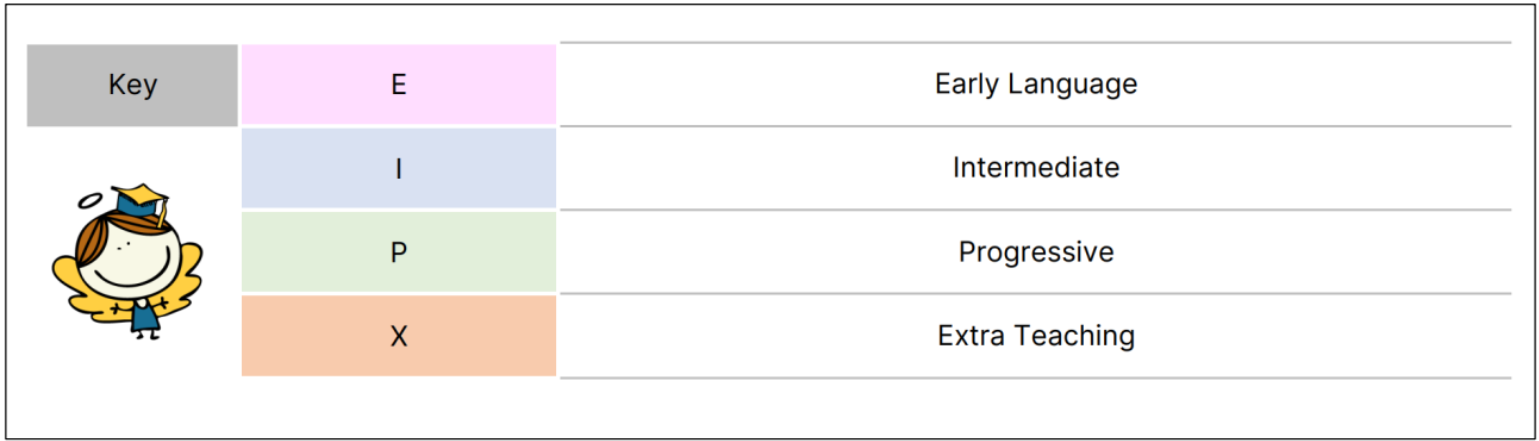
Unit Overview |
Kingfishers – Year 3 & 4 |
Ravens – Year 5 & 6 |
||
|
|
Year A |
Year B |
Year A |
Year B |
|
Autumn |
I am learning French – J’apprends le Francais (E) Animals – les animaux (E) |
Presenting Myself – Je me présente (I) Fruits – les fruits (E) |
At School – Á l’école (P) Clothes – les vetements (I) |
My family - ma famille (I) The date – la date (I) |
|
Spring |
Instruments – les instruments (E) Vegetables – les legumes (E) |
Seasons – les saisons (E) In the classroom – En Classe (I) |
At the tea room – Au salon de thé (I) My home – chez moi (I) |
What’s the weather like? – Que temps fait-il? (I) The weekend – Le week-end (P) |
|
Summer |
Shapes – les forms (E) Goldilocks and the three bears - Boucle d'or et les Trois Ours (I)
|
Ice Creams – les glaces (E) Little Red Riding Hood - Le Petit Chaperón Rouge (E) |
Do you have a pet? – As-tu un animal? (I) |
Traditions and celebrations – traditions et célébrations (I) |
Curriculum Drivers
-
Oracy: Pupils become articulate communicators in both English and French, building confidence through active speaking and listening.
-
Diversity: Lessons celebrate different cultures and promote inclusivity, ensuring all pupils feel valued.
-
Creativity: Activities encourage imaginative thinking and problem-solving in language use.
-
Independence: Pupils develop resilience and strategies to overcome challenges in language learning.
The Three Pillars of Language Learning
Together, the three pillars of phonics, vocabulary and grammar ensure pupils can read, write, speak, and understand the language confidently. They work in harmony: phonics supports reading and pronunciation, vocabulary gives content, and grammar provides structure.
-
Phonics: Building accurate pronunciation and decoding skills.
-
Vocabulary: Expanding core and thematic language for real communication.
-
Grammar: Introducing and revisiting structures progressively to enable confident speaking and writing.
Mixed-Age Flexibility
Our planning and curriculum supports our mixed-age classes through a rolling programme, ensuring progression for all pupils without repetition. Units are allocated by language level rather than year group, with differentiated resources and challenge built in.